Book Flights to Singapore
Singapore Airlines flies the longest nonstop commercial route on Earth from Newark to Changi, an 18-hour testament to how far this small island nation has pushed both aviation and its own transformation from fishing port to one of the wealthiest cities in Asia in a single lifetime.
Singapore Airlines and United are the only carriers flying nonstop, while Emirates, Qatar Airways and East Asian carriers offer competitive one-stop alternatives via their hubs. FareOptic compares every routing into SIN.
Cheap Flight Deals to Singapore


*All above fares are one way/round trip. Fares incl. all fuel surcharges, taxes & fees and our service fees. Displayed fares are subject to change and cannot be guaranteed at the time of booking. See all booking terms and conditions.
Recommended for your next trip
Based on popular routes and current airfare deals
Why Visit Singapore?
Vertical gardens that generate their own power, hawker food so essential to daily life that UNESCO protected it, and a multi-ethnic history layered into three living, distinct city quarters.
Gardens by the Bay and the Supertree Grove
A 101-Hectare Nature Park Featuring Iconic Vertical Gardens Up to 50 Meters Tall, Illuminated in a Nightly Light ShowGardens by the Bay, a 101-hectare nature park in central Singapore opened in 2012 as part of the country's broader long-term strategy to establish itself as a genuine 'City in a Garden' rather than merely a garden city with scattered green space, is anchored by its Supertree Grove, a collection of 18 tree-like vertical structures ranging from 25 to 50 meters tall that function as living plant displays, vertical gardens and, in several cases, integrated solar energy collection and rainwater harvesting systems, giving them genuine ecological function beyond their striking visual design. The Supertrees are illuminated nightly in the Garden Rhapsody light and sound show, a free evening spectacle that draws substantial crowds and has become one of Singapore's most recognizable and frequently photographed tourist experiences.
The Cloud Forest and Flower Dome Conservatories
Within Gardens by the Bay, two large climate-controlled conservatories, the Cloud Forest and the Flower Dome, offer additional paid attractions: the Cloud Forest recreates a cool, misty mountain ecosystem around a 35-meter indoor waterfall, one of the tallest indoor waterfalls in the world, surrounded by lush tropical mountain vegetation, while the Flower Dome, recognized by Guinness World Records as the largest glass greenhouse in the world by floor area, maintains a cool, dry Mediterranean-like climate showcasing plants from regions including the Mediterranean, South Africa and parts of South America, with rotating seasonal flower displays. Both conservatories provide a genuinely comfortable, air-conditioned respite from Singapore's typically hot and humid outdoor climate, making them a popular midday stop for visitors managing the heat during a full day of sightseeing.
Marina Bay Sands and Singapore's Modern Skyline
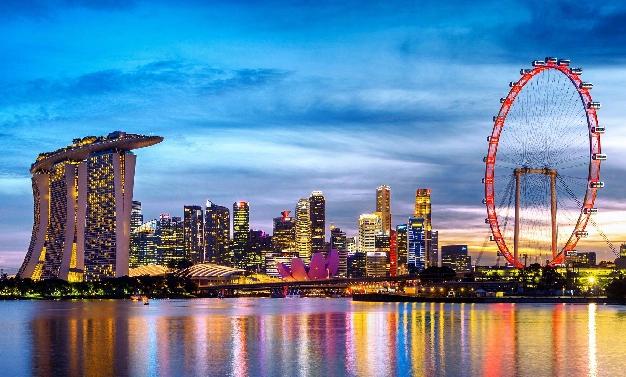
A Distinctive Three-Tower Resort Complex Topped by a 340-Meter Rooftop Infinity Pool, Symbolizing Singapore's Rapid Post-Independence DevelopmentMarina Bay Sands, an integrated resort complex completed in 2010 comprising three 55-story hotel towers connected at the top by a single elongated platform structure resembling a ship, houses one of the most recognizable rooftop features in the world: a 150-meter infinity pool spanning the connecting platform at a height of roughly 200 meters, offering guests panoramic views over the Marina Bay skyline and, on clear days, out toward the Singapore Strait, though the pool itself is reserved for hotel guests, with non-guests able to access a separate observation deck on the same level for a paid ticket offering comparable, if pool-free, views. The complex, developed by Las Vegas Sands and including a casino, luxury shopping mall, museum and convention facilities, has become a defining symbol of Singapore's transformation from a modest post-independence trading port into one of the wealthiest and most architecturally ambitious cities in Asia within a few decades.
The Marina Bay Waterfront and the Merlion
The broader Marina Bay waterfront, including the promenade connecting Marina Bay Sands to Gardens by the Bay and the historic Merlion Park, holds the Merlion statue, a half-lion, half-fish mythical creature that has served as Singapore's official tourism mascot and one of its most recognized symbols since the 1970s, combining a lion, referencing the country's name (Singapura, from Sanskrit for 'Lion City'), with a fish tail representing Singapore's origins as a fishing village and its ongoing identity as a major maritime port. The Spectra light and water show, projected onto the bay's waterfront most evenings, and the general evening promenade atmosphere along the bay, with the illuminated skyline reflected in the water, make an evening walk along Marina Bay one of the more consistently rewarding low-cost activities available to visitors regardless of budget for the paid attractions elsewhere in the immediate area.
Hawker Centers and Singapore's UNESCO-Recognized Food Culture
Singapore's Hawker Culture Was Inscribed as UNESCO Intangible Cultural Heritage in 2020, Reflecting the Genuinely Central Role of Communal Open-Air Food Courts in Daily LifeSingapore's hawker centers, open-air complexes housing dozens to well over a hundred individual food stalls typically specializing in a single dish or narrow category of dishes, represent one of the most distinctive and genuinely essential aspects of Singaporean daily life and culinary identity, and UNESCO's 2020 inscription of Singapore's hawker culture as an element of Intangible Cultural Heritage of Humanity formally recognized both the food itself and the broader social function these centers serve as genuinely inclusive community dining spaces where Singaporeans across all income levels and ethnic backgrounds, reflecting the country's substantial Chinese, Malay and Indian populations, eat side by side on a daily basis, making hawker centers arguably Singapore's most socially significant public spaces rather than merely tourist attractions. Maxwell Food Centre and Chinatown Complex Food Centre, home to Hawker Chan, whose Soya Sauce Chicken Rice stall became the first hawker stall in the world to receive a Michelin star, are among the most visited by international travelers specifically seeking out award-recognized hawker food.
Signature Dishes and Navigating a Hawker Center
Essential Singaporean hawker dishes span the country's multi-ethnic culinary heritage: Hainanese chicken rice, poached or roasted chicken served with rice cooked in chicken fat and stock, generally considered close to a national dish; laksa, a spicy coconut-based noodle soup with regional variations including the Peranakan-influenced Katong laksa; char kway teow, stir-fried flat rice noodles with prawns, egg, bean sprouts and Chinese sausage; and roti prata, a South Indian-influenced flaky flatbread typically served with curry for dipping. Navigating a hawker center as a first-time visitor involves finding a table first (often by placing a tissue packet or personal item on it, a widely understood local practice called 'chope-ing' a seat), then visiting individual stalls to order and pay before returning to your table, with food generally delivered to you or, at some stalls, requiring you to carry it back yourself, and prices remaining genuinely inexpensive by Singapore's otherwise high overall cost of living, reflecting the hawker system's origin and continuing government-supported role as an affordable food option for all residents.
Sentosa Island and Singapore's Family and Leisure Attractions
A Resort Island Connected to the Mainland by a Short Causeway or Cable Car, Holding Universal Studios, Beaches and a Historic Colonial-Era FortSentosa Island, a resort island just off Singapore's southern coast connected to the mainland by a short causeway, monorail, cable car or pedestrian boardwalk, has been developed extensively since the 1970s into one of Singapore's primary leisure and family entertainment destinations, anchored by Universal Studios Singapore, the only Universal Studios theme park in Southeast Asia, alongside S.E.A. Aquarium, one of the largest aquariums in the world by volume at the time of its opening, several artificial and semi-natural beaches, golf courses, and a cable car system offering aerial views over the island and out toward the busy shipping lanes of the Singapore Strait, one of the world's busiest and most strategically significant maritime chokepoints. The island's name, meaning 'peace and tranquility' in Malay, was adopted in the 1970s specifically as part of the government's tourism rebranding effort, replacing the island's earlier name, Pulau Blakang Mati, which carried considerably darker historical connotations related to the island's past.
Fort Siloso and Sentosa's Wartime History
Fort Siloso, a former British coastal artillery fort on Sentosa's western tip dating to the late 19th century and significantly expanded through the early 20th century as part of Singapore's broader colonial-era coastal defense network, played a role in the Second World War during the Japanese invasion and subsequent occupation of Singapore, and the preserved fortifications, tunnels and artillery pieces now operate as a museum documenting this history, offering a genuinely substantive historical counterpoint to Sentosa's otherwise overwhelmingly leisure-and-entertainment-focused modern identity. The broader story of Singapore's fall to Japanese forces in February 1942, considered one of the most significant British military defeats of the war, and the subsequent occupation period, is covered in greater depth at other sites around Singapore, including the National Museum of Singapore, for visitors wanting fuller historical context beyond Fort Siloso's more narrowly focused coastal defense exhibits.
Singapore's Ethnic Enclaves — Chinatown, Little India and Kampong Glam
Historically Distinct Ethnic Quarters Reflecting Singapore's Colonial-Era Urban Planning and Its Ongoing Multi-Ethnic IdentitySingapore's historic ethnic enclaves, Chinatown, Little India and Kampong Glam (the historic Malay and Arab quarter), trace their origins substantially to urban planning decisions made under British colonial administration in the early 19th century, when Sir Stamford Raffles's 1822 town plan designated specific areas for different ethnic communities, a system that, while rooted in colonial-era racial categorization rather than organic community formation alone, produced neighborhoods that developed genuine, deeply rooted cultural, religious and commercial identities over the subsequent two centuries that persist and remain vibrant today even as Singapore's population has become considerably more integrated and mobile than the original colonial planning envisioned. Each neighborhood holds significant religious architecture reflecting its community, including the Buddha Tooth Relic Temple and Sri Mariamman Temple in Chinatown, the Sri Veeramakaliamman Temple in Little India, and the Sultan Mosque in Kampong Glam, alongside dense concentrations of specialty shops, restaurants and street markets reflecting each community's specific culinary and commercial traditions.
Peranakan Culture and the Blending of Traditions
Beyond the three primary ethnic enclaves, Singapore's Peranakan community, descendants of intermarriage between early Chinese immigrants and local Malay populations dating back several centuries, developed a distinct, genuinely blended culture with its own language (Baba Malay), cuisine (incorporating Chinese ingredients and techniques with Malay and Indonesian spicing), and decorative arts, most visibly represented today in the colorful shophouse architecture found in areas like Katong and parts of Joo Chiat, and in the Peranakan Museum, which documents this specific hybrid culture's history and material culture in considerable depth. Understanding this additional layer of cultural blending, distinct from but related to the country's three primary ethnic communities, gives visitors a fuller picture of Singapore's genuinely complex, multi-layered ethnic and cultural history beyond a simplified three-category framework.
How to Find Cheap Flights to Singapore
Compare the Nonstop Singapore Airlines and United Routes Against One-Stop Alternatives
The nonstop flights, particularly Singapore Airlines' record-setting Newark route, offer the shortest total travel time but often at a premium fare. Emirates via Dubai, Qatar Airways via Doha, or East Asian carriers via Hong Kong, Tokyo or Seoul frequently offer meaningfully lower fares with just one additional stop — worth comparing carefully against the time saved by flying nonstop.
Book the Ultra-Long-Haul Nonstop Well in Advance for the Best Fares and Seat Selection
Singapore Airlines' Newark-Singapore route uses specially configured, reduced-capacity aircraft given the extreme flight length, meaning fewer seats are available overall compared to a standard widebody configuration. If the nonstop route is a priority, particularly for premium cabins, book well ahead of your travel dates.
Consider a Stopover in the Middle East or East Asia to Break Up the Journey
Given how long any Singapore routing takes from the US, a stopover of a day or more in Dubai, Doha, Hong Kong, Tokyo or Seoul can turn an exhausting one-way marathon into two more manageable legs, and several of these carriers and their home countries actively promote stopover programs that can add meaningfully to a trip at little or no extra airfare cost.
Singapore's Weather Is Consistently Hot and Humid Year-Round — There's No Strongly Preferable Season for Flights
Unlike many destinations, Singapore's near-equatorial location means temperature and humidity remain fairly consistent throughout the year, so flight pricing tends to follow global travel demand patterns (holidays, school breaks) more than any Singapore-specific seasonal weather pattern. Book based on standard low-demand periods rather than a particular Singapore 'season.'
Airlines Flying to Singapore (SIN)
Singapore Airlines
The World's Longest Nonstop Commercial Flight Runs From Newark to Singapore, Operated by Singapore AirlinesSingapore Airlines, consistently ranked among the world's top carriers for service quality, operates the longest nonstop scheduled commercial passenger flight in the world, connecting Newark Liberty to Singapore Changi over a route of roughly 15,300 kilometers and a flight time typically around 18 hours, made possible by specially configured ultra-long-range Airbus A350-900ULR aircraft carrying reduced passenger loads and additional fuel capacity rather than the airline's standard configuration used on shorter routes. Beyond this record-setting Newark route, Singapore Airlines also flies nonstop from Los Angeles, San Francisco and New York JFK, giving it the most extensive direct US network of any single carrier serving Singapore and reflecting the airline's position as Singapore's flag carrier and one of the most significant hub operations in Southeast Asia.
Key Routes
Singapore Airlines nonstop from EWR (the world's longest scheduled commercial flight, ~18 hours), JFK, LAX and SFO to SIN; specially configured ultra-long-range A350-900ULR aircraft used on the Newark route; extensive onward connections across Southeast Asia, Australia and beyond from Changi hub
United Airlines
The Only US Carrier Operating Nonstop Service to Singapore, From Its Chicago and Washington HubsUnited Airlines operates nonstop service to Singapore from both Chicago O'Hare and Washington Dulles, making it the only US-based carrier flying the route directly and giving American travelers loyal to a US airline's own metal and frequent flyer program a genuine nonstop option rather than requiring a switch to Singapore Airlines or a connecting itinerary through another Asian or Middle Eastern hub. These are among the longest routes in United's network, and the airline has periodically adjusted specific routing and aircraft assignment on this market based on demand and broader network planning, so checking current route status for your specific dates is worthwhile.
Key Routes
United Airlines nonstop from ORD and IAD to SIN; the only US carrier operating this route directly; among the longest flights in United's network given the extreme distance to Singapore
Connecting via the Middle East or East Asia
Emirates, Qatar Airways, Cathay Pacific and Others Offer One-Stop Alternatives That Can Sometimes Undercut the Nonstop FaresGiven the significant length and correspondingly high fares often associated with the nonstop Singapore Airlines and United routes, many travelers find genuinely competitive one-stop alternatives through Gulf carriers including Emirates via Dubai and Qatar Airways via Doha, or through East Asian hub carriers including Cathay Pacific via Hong Kong, Japan Airlines or ANA via Tokyo, and Korean Air via Seoul, all of which connect a very wide range of US cities to Singapore with a single change of aircraft. While these routings add total journey time compared to the nonstop options, they frequently offer meaningfully lower fares and, in the case of the Gulf and East Asian carriers, generally well-regarded long-haul products in their own right.
Key Routes
Emirates via Dubai DXB; Qatar Airways via Doha DOH; Cathay Pacific via Hong Kong HKG; Japan Airlines and ANA via Tokyo; Korean Air via Seoul ICN; all connect from a wide range of US cities and can offer competitive fares against the nonstop Singapore Airlines and United options
Things to Do in Singapore
Important Information Before You Fly to Singapore
Currency
Singapore dollar (SGD) — highly card- and app-friendly, though cash is useful at many hawker stalls
Language
English, Mandarin, Malay and Tamil are all official — English is the language of business and government
Time Zone
SGT (UTC+8), no daylight saving observed
Country Code
+65 (Singapore)
Airport Code
SIN — Changi Airport, ~20 km northeast of the city, 20-30 min by taxi or MRT
US Visa Required
No visa for short tourist stays up to 90 days; an electronic SG Arrival Card is required before or on arrival
Power Plugs
Type G — 230V / 50Hz; an adapter is needed for US devices
Emergency Number
999 (Police) / 995 (Ambulance and Fire)
Most Popular Airlines
Best Airlines for Domestic & International Routes


Frequently Asked Questions on Travel to Singapore
Everything you need to know about booking cheap flights to Singapore
What airport serves Singapore?
Singapore Changi Airport (IATA: SIN), consistently rated among the world's best airports, sits about 20 kilometers northeast of the city center, roughly 20 to 30 minutes by taxi or MRT train. It's served nonstop by Singapore Airlines from Newark, New York JFK, Los Angeles and San Francisco, and by United Airlines from Chicago and Washington Dulles.
Is Singapore Airlines' flight from Newark really the longest in the world?
Yes — the Newark to Singapore route, at roughly 15,300 kilometers and about 18 hours, is the longest nonstop scheduled commercial passenger flight in the world. Singapore Airlines operates it with specially configured ultra-long-range Airbus A350-900ULR aircraft carrying reduced passenger loads and additional fuel capacity.
Should I fly nonstop or connect through another hub to Singapore?
It depends on your priorities. Singapore Airlines and United offer the only nonstop options, saving total travel time but often at a fare premium. Connecting through Dubai, Doha, Hong Kong, Tokyo or Seoul on Emirates, Qatar Airways, Cathay Pacific, Japan Airlines, ANA or Korean Air frequently offers meaningfully lower fares with one stop, and some travelers use the connection as an opportunity for a stopover.
What is hawker food and where should I try it?
Hawker centers are open-air complexes of dozens to over a hundred individual food stalls, each typically specializing in one dish, and they're so central to Singaporean daily life and culinary identity that UNESCO inscribed the country's hawker culture as Intangible Cultural Heritage in 2020. Maxwell Food Centre and Chinatown Complex Food Centre (home to a Michelin-starred stall) are popular starting points. Try Hainanese chicken rice, laksa, char kway teow and roti prata.
What is Gardens by the Bay?
A 101-hectare nature park in central Singapore featuring the Supertree Grove — 18 tree-like structures up to 50 meters tall with integrated solar and rainwater systems, illuminated nightly in a free light show — plus two paid climate-controlled conservatories, the Cloud Forest (with a 35-meter indoor waterfall) and the Flower Dome (the world's largest glass greenhouse by floor area).
Do US citizens need a visa for Singapore?
No visa is required for US citizens for short tourist stays, typically up to 90 days. A valid passport is required, generally with at least six months of remaining validity. Singapore has a Sustainable Development Levy that may be included in accommodations, and an electronic arrival card (SG Arrival Card) must be submitted before or upon arrival — confirm current requirements before traveling.
What currency is used in Singapore?
The Singapore dollar (SGD). Singapore is highly card- and app-friendly, with contactless payment widely accepted, though cash remains useful at many hawker center stalls, which sometimes prefer or require it.
Is there a good time of year to visit Singapore?
Singapore's near-equatorial location means temperature and humidity stay fairly consistent year-round, with no dramatically preferable season the way there is for many other destinations. Flight pricing tends to follow global travel demand patterns like holidays and school breaks rather than any Singapore-specific weather season.
24/7 Post-Flight Booking Assistance
With our 24/7 Post-Flight Booking Assistance, you will never have to manage travel challenges alone. Our highly trained travel experts are available day and night to support you with any changes, cancellations, or additional services you may require. From updating passenger details to securing special requests, we make the process smooth and stress-free.
Should your plans shift, we will walk you through every step of the cancellation and refund process, ensuring clarity and timely resolutions. In today's unpredictable travel environment, flexibility is essential, and we pride ourselves on delivering expert solutions quickly. Contact us anytime and travel with confidence knowing we will handle the details while you focus on what matters most — your journey.