Book Flights to Dubai, UAE
Dubai — built from desert in two generations — is the world's most audacious city: the world's tallest building (828m Burj Khalifa), the world's busiest international airport, the world's largest mall, the world's most choreographed fountain, and an old creek-side gold souk where 25 tonnes of gold is on display at any moment.
Emirates flies nonstop from 10+ US cities. US citizens enter visa-free (30 days, free, on arrival). October–April is ideal (20-30°C). FareOptic finds the best Emirates fares.
Cheap Flight Deals to Dubai

*All above fares are one way/round trip. Fares incl. all fuel surcharges, taxes & fees and our service fees. Displayed fares are subject to change and cannot be guaranteed at the time of booking. See all booking terms and conditions.
Recommended for your next trip
Based on popular routes and current airfare deals
Why Visit Dubai, UAE?
The world's tallest building at sunset. The world's largest fountain choreographed to music. A desert safari through 150m dunes 45 minutes from the city. And in a wind-tower alleyway in Deira — 25 tonnes of gold in shops unchanged since before the skyscrapers. Dubai contains multitudes.
Burj Khalifa — 828 Metres, the World's Tallest Building
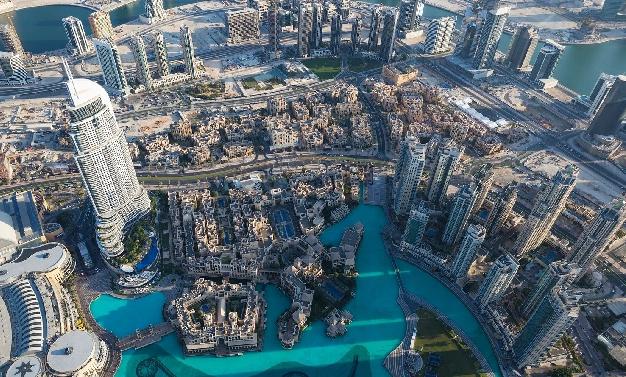
The Top of the World — 124th, 125th, and 148th Floor Observation DecksThe Burj Khalifa (828m, 163 floors — designed by Adrian Smith of Skidmore, Owings & Merrill, opened January 4, 2010) is the world's tallest building by every metric: tallest structure, highest occupied floor (163rd), highest observation deck (148th floor, At the Top Sky — 555m), highest restaurant (Atmosphere, 122nd floor), highest nightclub (Vault, 144th floor). The building is the centerpiece of Downtown Dubai — a new city district built from desert in the 2000s.
How Tall Is 828 Metres?
828 metres is: 2 Empire State Buildings (443m × 2 = 886m — close). The Burj Khalifa is visible from 95 km away. The upper floors penetrate a jet stream — so the top 50 floors are in a different wind environment than the bottom 50. At the 148th floor observation deck, you are above most clouds that form in Dubai. The building has its own water cooling and condensation systems (it produces approximately 15 million gallons of condensate water annually — enough to fill 20 Olympic swimming pools). The foundation required 50,000 tonnes of concrete and 900 tonnes of steel.
Dubai Mall and the Dubai Fountain
The World's Largest Shopping Mall by Total Area — and the World's Largest FountainThe Dubai Mall (adjacent to the Burj Khalifa) is the world's largest shopping mall by total area (502,000 m² — larger than 50 football fields): 1,200+ retail outlets, the Dubai Aquarium and Underwater Zoo (1,000+ aquatic animals including 300+ sharks and rays in a 10-million-litre tank — the aquarium face is one of the world's largest acrylic panels at 32.88m × 8.3m), an Olympic-size ice skating rink, the Dubai Dino (a 155-million-year-old Diplodocid skeleton), and a 30-metre waterfall.
The Dubai Fountain — the World's Largest Choreographed Fountain
The Dubai Fountain (on the Burj Khalifa Lake, outside the Dubai Mall) is the world's largest choreographed fountain system: 275 metres long, illuminated by 6,600 lights and 25 colour projectors, with water jets reaching 150 metres — equivalent to a 50-storey building. Evening performances (every 30 min after 6pm) choreograph water jets to Arabic and Hindi music. Abra (traditional wooden boat) rides on the lake during performances are available for close-up views. The fountain cost $218 million to build.
Desert Safari and Dune Bashing
The Arabian Desert 45 Minutes from Downtown DubaiThe Arabian Desert surrounding Dubai — the Rub' al Khali ('Empty Quarter') edges begin 45 minutes from the city — provides the most dramatic contrast to Dubai's urban spectacle: dune bashing (4WD over steep sand dunes at high speed), sandboarding, camel riding, falconry demonstrations, and a traditional Bedouin camp dinner under the stars (Arabic coffee, dates, hummus, shawarma, and shisha). The red dunes of the Dubai desert reach 150-200m in height.
The Rub' al Khali — The World's Largest Sand Desert
The Rub' al Khali (Empty Quarter) — which Dubai's desert connects to — is the world's largest continuous sand desert: 650,000 km² across Saudi Arabia, the UAE, Oman, and Yemen. Sand dunes reach 250m in height. The interior of the Empty Quarter is one of the least visited places on Earth; the Dubai desert safari accesses the accessible northern fringe of this extraordinary landscape. The desert's red colour comes from iron oxide coating the quartz sand grains — the same iron oxide that gives Mars its red colour, at a much smaller scale.
Old Dubai — Al Fahidi, Gold Souk, and Spice Souk
The Creek, Wind Towers, and Dubai Before the SkyscrapersOld Dubai (Bur Dubai and Deira districts, around the Dubai Creek) provides a window into the pre-oil city: Al Fahidi Historical Neighbourhood (formerly Al Bastakiya — a district of traditional wind-tower courtyard houses, the oldest neighbourhood in Dubai, built in the 1890s-1920s by Persian merchants from Bastak); the Gold Souk (Deira — approximately 25 tonnes of gold on display at any given time, the world's largest gold souk with 380+ retailers); the Spice Souk (adjacent — saffron, frankincense, cardamom, dried limes); and abra (traditional wooden boat) crossings of the Dubai Creek (50 fils — $0.14 — one of the world's cheapest public transport services).
The Wind Tower — Pre-Air Conditioning Desert Architecture
The wind towers (barjeel in Arabic) visible in Al Fahidi Historical Neighbourhood are Dubai's most distinctive traditional architectural feature: tall square towers with openings on all four sides that catch prevailing breezes and funnel cool air downward into the rooms below — an ingenious passive cooling system developed in the Persian Gulf and Iranian plateau centuries before electricity. The towers work by creating differential air pressure: warm air rises and exits from the upper openings while cooler air is drawn down from any side that catches a breeze. The Al Fahidi neighbourhood has Dubai's best-preserved collection of wind towers.
How to Find Cheap Flights to Dubai
Emirates Flies Nonstop from 10+ US Cities — Book 3-4 Months Ahead for Best Fares
Emirates operates the world's most extensive US–Dubai nonstop network. Fares are competitive when booked 8-12 weeks ahead. Emirates' Economy Saver fares are priced aggressively on the JFK, LAX, and ORD routes. Business Class fares can be discounted significantly in shoulder season (April-May, September-October). Consider booking the A380 for the first class bar experience.
US Citizens Enter Dubai Visa-Free — 30 Days, Free, on Arrival
US citizens receive a free 30-day visitor visa on arrival at Dubai International Airport (DXB) — no application or fee required. Simply present your US passport. Extension is available for another 30 days at the GDRFA (General Directorate of Residency and Foreigners Affairs). Passport must be valid for at least 6 months beyond arrival.
October–April Is Ideal — Avoid June–September Heat (40-48°C)
Dubai's climate is extreme. October–April (20-30°C, sunny) is ideal for all outdoor activities. May and September are shoulder season (32-38°C — hot but manageable with AC). June–August is brutally hot (40-48°C, high humidity on coastal areas) — tourism infrastructure is air-conditioned but outdoor activity is severely limited. July-August has the lowest prices precisely because of the heat.
Dubai Is Extremely Family-Friendly — Legoland, IMG Worlds, Atlantis Aquaventure
Dubai has invested heavily in family entertainment: Atlantis Aquaventure (the largest waterpark in the Middle East, on Palm Jumeirah); IMG Worlds of Adventure (the world's largest indoor theme park); Legoland Dubai; Dubai Frame (150m tall picture frame building bridging old and new Dubai). The Dubai Metro (fully automated) connects major attractions. Many attractions discount significantly with the Dubai Pass.
Airlines Flying to Dubai (DXB)
Emirates
World's Largest Long-Haul Carrier — Nonstop from 10+ US Cities to DXBEmirates operates the world's most extensive nonstop network from the United States to Dubai (DXB): nonstop from New York JFK, Los Angeles LAX, San Francisco SFO, Chicago ORD, Washington Dulles IAD, Dallas DFW, Miami MIA, Seattle SEA, Boston BOS, Houston IAH, and more. Emirates' A380 and Boeing 777 fleet provides access to the iconic Emirates First Class suite with shower spa, and the award-winning Business Class flatbed. Dubai DXB is Emirates' exclusive hub.
Key Routes
Emirates nonstop from New York JFK (14 hrs), Los Angeles LAX (17 hrs), San Francisco SFO (16 hrs), Chicago ORD (14 hrs), Washington IAD (14 hrs), Dallas DFW (15 hrs), Miami MIA (14 hrs), Seattle SEA (16 hrs), Boston BOS, Houston IAH to Dubai DXB; connections to 150+ destinations via DXB
United Airlines via FRA/LHR
Star Alliance — Connections via European Hubs to DXBUnited Airlines connects from US cities to Dubai via Frankfurt (FRA, Lufthansa connection) or London Heathrow (LHR, United partner connection) or directly with United's own Boeing 777 service. United's Dubai DXB service is a strong alternative to Emirates for travelers preferring Star Alliance miles or connecting from United's hub cities.
Key Routes
United Airlines nonstop from Newark EWR and Washington IAD to Dubai DXB; United connections via Frankfurt FRA, London LHR to DXB; codeshare options on Lufthansa, British Airways, and Emirates via SkyTeam/Oneworld partners
Flydubai & Air Arabia
Budget Connections Within the RegionFlydubai (Dubai government-owned budget carrier, IATA: FZ) and Air Arabia (Abu Dhabi-based) operate extensive short-haul networks connecting Dubai to secondary Middle Eastern, Central Asian, and African cities — useful for onward connections from Dubai to destinations not served by Emirates. Flydubai and Emirates codeshare on select routes.
Key Routes
Flydubai from Dubai DXB to 90+ destinations across MENA, Caucasus, Central Asia, East Africa, and Indian Subcontinent; Air Arabia from Sharjah SHJ to 170+ short-haul destinations
Things to Do in Dubai
Important Information Before You Fly to Dubai
Currency
UAE Dirham (AED, Dhs) — pegged to USD at 3.67 AED/$1; cards accepted universally
Language
Arabic (official); English widely spoken — Dubai is one of the world's most international cities
Time Zone
GST — UTC+4 (no daylight saving time; year-round)
Country Code
+971 (UAE)
Airport Code
DXB — Dubai International Airport (4.6 km from Deira; Metro Red Line)
US Visa Required
No — free 30-day visa on arrival at DXB for US citizens; no application required
Power Plugs
Type G — 220V / 50Hz; UK 3-pin plugs; adapter required for US devices
Emergency Number
999 (Police); 998 (Ambulance); 997 (Fire)
Most Popular Airlines
Best Airlines for Domestic & International Routes


Frequently Asked Questions on Travel to Dubai
Everything you need to know about booking cheap flights to Dubai, UAE
What airport serves Dubai?
Dubai International Airport (IATA: DXB) is the world's busiest international airport by passenger numbers and the exclusive hub of Emirates. Located 4.6 km from Deira (Old Dubai) and 12 km from Downtown. Dubai Metro Red Line connects DXB Terminal 1/3 to downtown and the Mall of the Emirates (30-40 min). Terminal 3 is exclusively Emirates and is one of the world's largest terminal buildings. Dubai also has Al Maktoum International Airport (DWC) — the planned 'Dubai World Central' with enormous expansion plans — currently used for cargo and some budget carriers.
Do US citizens need a visa for Dubai?
No. US citizens receive a free 30-day visitor visa on arrival at Dubai International Airport (DXB) — no application, no fee, no photo required. Simply present your US passport (valid for 6+ months beyond arrival). A 30-day extension is available at the General Directorate of Residency and Foreigners Affairs (GDRFA). Note: a separate UAE tourist visa is required for land border crossings; the visa on arrival applies to airport arrivals only.
What is the Burj Khalifa?
The Burj Khalifa (828m, 163 floors, opened January 4, 2010) is the world's tallest building — designed by Adrian Smith of SOM, built by Samsung C&T. Three observation decks: At the Top (124th/125th floor, 452m — included in many Dubai passes); At the Top Sky (148th floor, 555m — more expensive, spectacular view above most clouds). Tickets must be booked online in advance (walk-up tickets are more expensive and often sold out). Avoid midday; sunrise and sunset are most spectacular.
What are the best things to do in Dubai for a first-time visitor?
First-time itinerary: Day 1 — Burj Khalifa observation deck (pre-book), Dubai Mall, Dubai Fountain (evening); Day 2 — Old Dubai (Al Fahidi, Gold Souk, Spice Souk, abra creek crossing, Dubai Museum), Palm Jumeirah evening; Day 3 — Desert safari (book through hotel or reputable operator, departs 3pm, returns midnight). Day trip: Abu Dhabi Sheikh Zayed Grand Mosque (1.5 hr drive or taxi). Optional: Dubai Frame, Dubai Museum of the Future.
What are Dubai's laws that visitors should know?
Dubai has laws that differ from Western norms: public intoxication is illegal (alcohol permitted only in licensed hotel bars and restaurants; off-licences exist but discreet); public displays of affection are illegal (holding hands is generally tolerated for married couples; kissing in public is not); unmarried couples sharing a hotel room is technically illegal but rarely enforced at international tourist hotels; photography of government buildings, military installations, and some private individuals without permission is restricted. Dress code: shoulders and knees should be covered in souqs and traditional areas; swimwear at hotel pools only.
What currency is used in Dubai?
UAE Dirham (AED, Dhs). Exchange rate: approximately 3.67 AED per USD (pegged to the US dollar). Cards and contactless payment are universal in Dubai — cash is rarely necessary. ATMs are widely available. US credit and debit cards work without fees at most Dubai ATMs. Dubai's duty-free at DXB is one of the world's finest (and cheapest) — particularly for gold, perfume, electronics, and liquor.
Is Dubai expensive?
Dubai has a reputation for luxury but is more affordable than the perception: mid-range hotels (4-star) run $80-150/night; the Dubai Metro is extremely cheap (around $1-2/trip); street-level shawarma meals are $3-5; the abra creek crossing is $0.14. The Dubai Mall, most museums, and beaches are free or very cheap to enter. Luxury options (Burj Al Arab, Emirates First Class) are genuinely world-class but optional. Overall: comparable to London or New York for a typical tourist budget.
What is the best time of year to visit Dubai?
November–March is peak season: temperatures 20-28°C, low humidity, outdoor activities comfortable. December–January is coolest (15-25°C) and most popular. October and April are good shoulder season months. Avoid May–September: 38-48°C with high humidity makes outdoor sightseeing unpleasant. Ramadan (dates vary annually — check Islamic calendar) affects restaurant hours and public behaviour; some activities are restricted. However, Ramadan also offers unique cultural experiences and heavily discounted hotel rates.
24/7 Post-Flight Booking Assistance
With our 24/7 Post-Flight Booking Assistance, you will never have to manage travel challenges alone. Our highly trained travel experts are available day and night to support you with any changes, cancellations, or additional services you may require. From updating passenger details to securing special requests, we make the process smooth and stress-free.
Should your plans shift, we will walk you through every step of the cancellation and refund process, ensuring clarity and timely resolutions. In today's unpredictable travel environment, flexibility is essential, and we pride ourselves on delivering expert solutions quickly. Contact us anytime and travel with confidence knowing we will handle the details while you focus on what matters most — your journey.